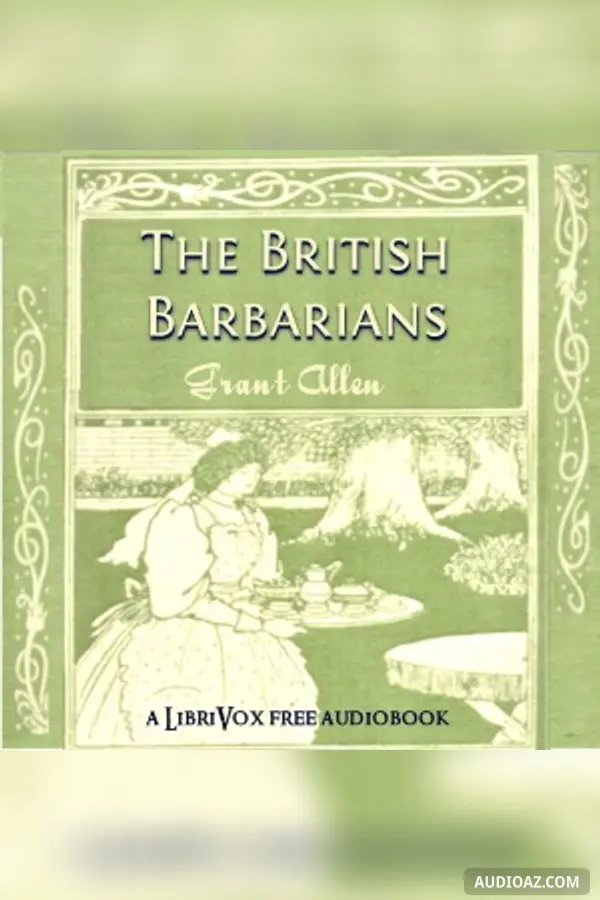
The Evolutionist at Large - Free Audiobook
1/24Poem and Preface
The Evolutionist at Large
A BALLADE OF EVOLUTION.
A BALLADE OF EVOLUTION.
In the mud of the Cambrian main
Did our earliest ancestor dive:
From a shapeless albuminous grain
We mortals our being derive.
He could split himself up into five,
Or roll himself round like a ball;
For the fittest will always survive,
While the weakliest go to the wall.
As an active ascidian again
Fresh forms he began to contrive,
Till he grew to a fish with a brain,
And brought forth a mammal alive.
With his rivals he next had to strive,
To woo him a mate and a thrall;
So the handsomest managed to wive,
While the ugliest went to the wall.
At length as an ape he was fain
The nuts of the forest to rive;
Till he took to the low-lying plain,
And proceeded his fellow to knive.
Thus did cannibal men first arrive,
One another to swallow and maul;
And the strongest continued to thrive,
While the weakliest went to the wall.
Envoy.
Prince, in our civilised hive,
Now money's the measure of all;
And the wealthy in coaches can drive,
While the needier go to the wall.
THE EVOLUTIONIST AT LARGE.
About
These Essays originally appeared in the columns of the 'St. James's Gazette,' and I have to thank the courtesy of the Editor for kind permission to republish them. My object in writing them was to make the general principles and methods of evolutionists a little more familiar to unscientific readers. Biologists usually deal with those underlying points of structure which are most really important, and on which all technical discussion must necessarily be based. But ordinary people care little for such minute anatomical and physiological details. They cannot be expected to interest themselves in the flexor pollicis longus, or the hippocampus major about whose very existence they are ignorant, and whose names suggest to them nothing but unpleasant ideas. What they want to find out is how the outward and visible forms of plants and animals were produced. They would much rather learn why birds have feathers than why they have a keeled sternum; and they think the origin of bright flowers far more attractive than the origin of monocotyledonous seeds or exogenous stems. It is with these surface questions of obvious outward appearance that I have attempted to deal in this little series. My plan is to take a simple and well-known natural object, and give such an explanation as evolutionary principles afford of its most striking external features. A strawberry, a snail-shell, a tadpole, a bird, a wayside flower—these are the sort of things which I have tried to explain. If I have not gone very deep, I hope at least that I have suggested in simple language the right way to go to work. - Summary by Grant Allen
Comments
Be the first to comment
There aren't any comments on this content yet. Start the conversation!
Discover More




More from Grant Allen