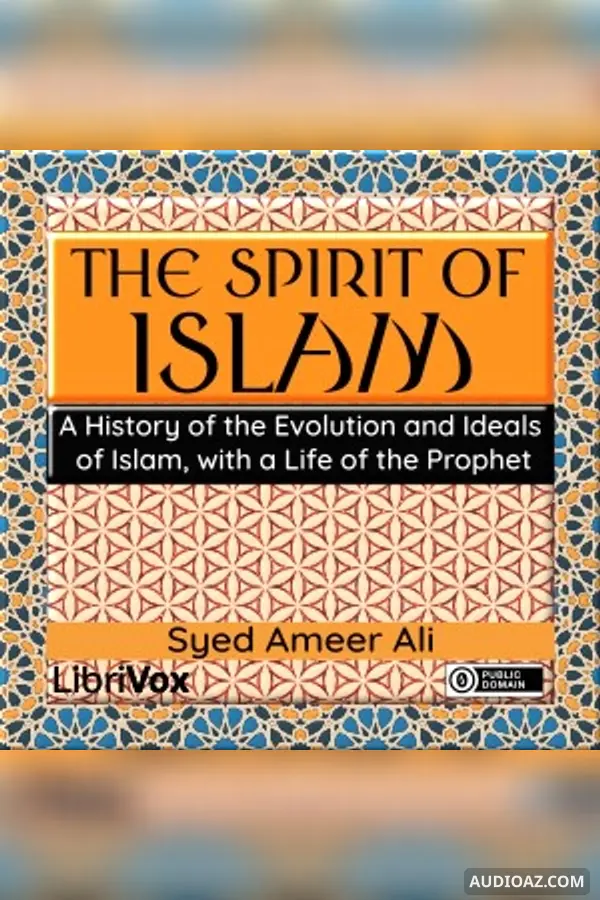
《The Spirit of Islam: A History of the Evolution and Ideals of Islam, with a Life of the Prophet》 - 免费有声读物
语言:English
1 / 46Preface
- 1. Preface
- 2. Introduction. The continuity of religious development--Bactria (Balkh) supposed to be the original seat of the human race--Dispersion of the races--Fetishism and Pantheism--The Eastern and Western Aryans--The Assyrians--Babylon and the Jews--Hinduism
- 3. Introduction, continued. Zoroastrianism--The Cult of Isis and of Mythra--Judaism--Christianity
- 4. Introduction, continued. Gnosticism--Manicheism--Degradation of the earlier creeds
- 5. Introduction, continued. The tribes of Arabia, their origin, their diversity of culture and religious conceptions--Idolatry among the Arabs--The folklore of Arabia--The advent of Mohammed, a necessity of religious development
- 6. Part I. The Life and Ministry of the Prophet. Chapter I. Mohammed the Prophet
- 7. Part I. Chapter I. Mohammed the Prophet (continued)
- 8. Part I. Chapter I. Mohammed the Prophet (continued)
- 9. Part I. Chapter II. The Hegira
- 10. Part I. Chapter III. The Prophet at Medina
- 11. Part I. Chapter IV. Hostility of the Koreish and the Jews
- 12. Part I. Chapter V. The Invasion of Medina
- 13. Part I. Chapter VI. The Prophet's Clemency
- 14. Part I. Chapter VII. The Diffusion of the Faith
- 15. Part I. Chapter VIII. The Year of Deputations
- 16. Part I. Chapter IX. Fulfilment of the Prophet's Work
- 17. Part I. Chapter X. The Apostolical Succession
- 18. Part II. The Spirit of Islam. Chapter I. The Ideal of Islam
- 19. Part II. Chapter II. The Religious Spirit of Islam
- 20. Part II. Chapter II. The Religious Spirit of Islam (continued)
- 21. Part II. Chapter III. The Idea of Future Life in Islam
- 22. Part II. Chapter IV. The Church Militant of Islam
- 23. Part II. Chapter V. The Status of Women in Islam
- 24. Part II. Chapter V. The Status of Women in Islam (continued)
- 25. Part II. Chapter VI. Bondage (Slavery)
- 26. Part II. Chapter VII. The Political Spirit of Islam
- 27. Part II. Chapter VII. The Political Spirit of Islam (continued)
- 28. Part II. Chapter VIII. The Political Divisions and Schisms of Islam. From their origins to the usurpation of Mu'awiyah
- 29. Part II. Chapter VIII (continued). The butchery of Kerbela--The triumph of paganism--The sack of Medina
- 30. Part II. Chapter VIII (continued). The rise of the Abbasides--The origin of the Sunni Church--Mâmûn
- 31. Part II. Chapter VIII (continued). Shiaism--Sunnism--The question of the Imâmate
- 32. Part II. Chapter VIII (continued). The principal Shiah sects
- 33. Part II. Chapter VIII (continued). The Paulicians--The doctrine of Abdullah ibn-Maimun al-Kaddah
- 34. Part II. Chapter VIII (continued). The Grand Lodge of Cairo--The assassins of Alamut
- 35. Part II. Chapter VIII (continued). The Ithna-`Asharias divided into Usulis and Akhbaris
- 36. Part II. Chapter VIII (continued). The Sunnis divided into Hanafis, Malikis, Shafeis, and Hanbalis
- 37. Part II. Chapter VIII (continued). The Kharijis--Babism
- 38. Part II. Chapter IX. The literary and scientific spirit of Islam
- 39. Part II. Chapter IX. The literary and scientific spirit of Islam (continued)
- 40. Part II. Chapter IX. The literary and scientific spirit of Islam (continued)
- 41. Part II. Chapter X. The rationalistic and philosophical spirit of Islam
- 42. Part II. Chapter X. The rationalistic and philosophical spirit of Islam (continued)
- 43. Part II. Chapter X. The rationalistic and philosophical spirit of Islam (continued)
- 44. Part II. Chapter X. The rationalistic and philosophical spirit of Islam (continued)
- 45. Part II. Chapter XI. Idealistic and mystical spirit of Islam
- 46. Part II. Chapter XI. Idealistic and mystical spirit of Islam (continued)
关于
Syed Ameer Ali was a prominent Indian jurist, author and political leader during the British Raj. In The Spirit of Islam he draws on his broad knowledge of Western historical research and Islamic sources to highlight the enlightened and socially progressive tendencies in the Islamic tradition. Some parts of the book counter the Orientalist scholarship of the time, which was largely hostile to Islam, while others articulate the author's vision of Islam as a modern faith. Pronunciation note: the Arabic words and names found in the text are pronounced based on their native form, rather than the spelling used by the author, which reflects Persian and Indian pronunciation. (Summary by Kazbek)
评论
成为第一个评论的人
此内容还没有任何评论。开始对话吧!
查看更多





标签: The Spirit of Islam: A History of the Evolution and Ideals of Islam, with a Life of the Prophet audio, The Spirit of Islam: A History of the Evolution and Ideals of Islam, with a Life of the Prophet - Syed Ameer Ali audio, 非小说类 audio, 其他宗教 audio, 宗教 audio, free audiobook, free audio book, audioaz